
Can rTMS treatments be shorter?
For treatment resistant-depression (TRD), there is a standard form of repetitive transcranial magnetic stimulation (rTMS) treatment. This form lasts for 37.5 minutes; a considerable amount of time for one treatment. The goal of this study was to see if the time rTMS treatments take can be reduced while remaining as effective by using a new form, called intermittent theta burst stimulation (iTBS).

Two-Sided rTMS Treatment is Better Than One-Sided for People With Treatment-Resistant Depression
Repetitive transcranial magnetic stimulation (rTMS) offers an alternative treatment for people with treatment-resistant depression. This study compared two-sided rTMS treatment to one-sided rTMS and sham (placebo) rTMS. This study also addressed limitations in other studies by using MRI to increase individualization of placing the rTMS device and extending the treatment weeks to up to six weeks.

Predicting rTMS Treatment Success for Depression Using Brain Connectivity
While repetitive transcranial magnetic stimulation (rTMS) is an effective therapy for TRD, it’s difficult to predict which patients will benefit most. To address this, finding biological markers (biomarkers) that can predict treatment response is a crucial goal for providing personalized care. This study used resting-state functional magnetic resonance imaging (fMRI) to explore brain activity patterns, aiming to discover neuroimaging biomarkers that can distinguish patients who will respond to rTMS from those who won’t.
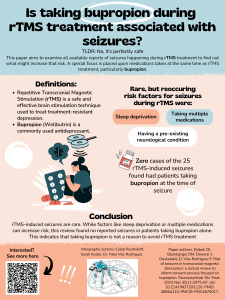
Is taking bupropion during rTMS treatment associated with seizures?
The researchers of this paper attempted to determine if seizure risk increased when receiving rTMS and taking an antidepressant called bupropion (Wellbutrin). Researchers found that while rTMS-induced seizures are uncommon and may be linked to factors like sleep deprivation, taking multiple medications, or pre-existing neurological conditions, the review found no cases of rTMS-induced seizures in patients taking bupropion alone. This suggests that taking bupropion should not be considered a reason to avoid rTMS treatment.

rTMS & Depression: Are there other regions we should treat?
People with depression have altered activity in some parts of the brain. To treat depression, we can attempt to change this altered activity by using rTMS. However, the brain region we typically apply rTMS to only achieves remission rates of 30% to 35%. This has led researchers to explore alternative target regions that may result in a higher remission rate.

Measuring the coordination of brain regions can predict who will benefit from rTMS for depression
In this study, researchers propose a possible measurement that may be able to predict if an individual will positively respond to repetitive transcranial magnetic stimulation (rTMS) treatment.

Magnetic Seizure Therapy (MST) can Treat Depression by Changing the Structure and Function of our Brains
Magnetic Seizure Therapy (MST) is similar to rTMS: it is a safe, painless, effective, and non-invasive way to treat even severe depression that hasn’t improved with antidepressants. MST also uses a device placed on the scalp to deliver a magnetic field that disrupts the brain’s electrical activity. However, MST is stronger. In fact, it is intended to elicit a closely-monitored seizure that is then thought to rewire the brain for the better. The researchers of the current study were wondering if changes in the brain structure (size) and function (activity) were related to improvements in depression after MST.
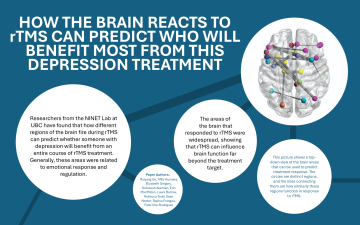
How the Brain Reacts to rTMS can Predict Who Will Benefit Most From this Depression Treatment
rTMS is a safe, non-invasive neurostimulation technique used to treat depression. It works by applying a coil to the scalp, which then delivers magnetic pulses that disrupts the way the brain functions in depression. Importantly, it is effective even for people who did not benefit from antidepressants. Predicting who might benefit best from rTMS is an important topic for researchers: it can help direct patients and clinicians to whatever treatments would be best for them. The researchers of the current study were wondering if how the brain reacts to rTMS can be used to predict whether someone with depression would benefit from this treatment. Specifically, how the functional connectivity between brain areas changes with rTMS.

Memory can improve after rTMS treatment for those with depression-related cognitive symptoms
Did you know that poor mood is not the only way to diagnose depression? In fact, cognitive impairment – worsened thinking, concentration, and decision making – is one of nine criteria for the disorder. This impairment is even more common and severe among those who have treatment-resistant depression: a particular case where someone does not improve with standard antidepressant medications. This study assessed changes to cognition 3 months post-rTMS among a group of people with treatment-resistant depression and compared it to people without depression.

Four Paths of Response to rTMS in Treatment-Resistant Depression
rTMS treatment outcomes are very diverse. Some may improve almost instantly, others may require a higher number or intensity of treatments, and others may not respond at all. Understanding the diversity of rTMS treatment responses can be important in order for clinicians and patients to find the best, personalized treatment approach for their depression. The aim of this study was to describe the number and pattern of unique pathways (i.e., trajectories) of improvement to rTMS among a large group of people with treatment-resistant depression.